
EN
News of 20ft Expandable Container Houses
I. Basic Parameters (Core Customer Inquiries)
1. Q: What are the dimensions of the 20ft expandable container house before and after expansion?
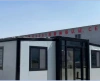
A: For 20ft expandable container house. Unfolded dimensions: L5900*W2200*H2480mm; Expanded dimensions: L5900*W6200*H2480mm. Total area approximately 37 square meters.
2.Q: What is the load-bearing capacity of the 20ft expandable container house? How much weight can the floor and roof bear?
A: The uniform floor load-bearing capacity is ≥200kg/㎡, which meets the needs of daily living, office furniture and equipment placement. The uniform roof load-bearing capacity is ≥150kg/㎡, which can bear snow accumulation and a small number of maintenance personnel operations. Some customized models can be equipped with photovoltaic panels (need to be stated in advance, and the load-bearing capacity can reach 300kg/㎡ after reinforcement).
3. Q: What is the dead weight and transportation weight of the 20ft expandable container house? Is it convenient for transportation?
A: The dead weight in the unexpanded state is about 3.5-4.2 tons (floating according to different configurations), and the transportation weight is consistent with the dead weight. When unexpanded, it is a standard container size, which can be directly transported by container truck without disassembly. One truck can transport 1-2 units with low transportation cost, suitable for multiple land and sea transportation methods.
4.Q: What is the approximate service life of the 20ft expandable container house?
A: The main steel structure adopts hot-dip galvanizing process, which is anti-corrosion and anti-rust, and the normal service life can reach 15-20 years. If daily maintenance is done well (such as regular repainting and checking sealants), the service life can be extended to more than 25 years. The service life of enclosure materials (wall panels, roof panels) is synchronized with the main body, and wearing parts (door and window seals) can be replaced as needed without affecting the overall use.
II. Configuration & Customization
1.Q: What does the basic configuration of the 20ft expandable container house include? Can it be customized on demand?
A: Standard basic configuration: hot-dip galvanized steel structure frame, rock wool sandwich wall panels/roof panels (fireproof and thermal insulation), broken bridge aluminum doors and windows, PVC flooring, integrated lighting, basic distribution box, water supply and drainage interfaces. Customization on demand is supported, such as replacing floor materials (solid wood, ceramic tiles), installing air conditioners/underfloor heating, upgrading sound insulation wall panels, adding bathroom/kitchen modules, reserving photovoltaic/charging pile interfaces, etc.
2.Q: Is the structure of the expandable part stable? Will it leak rain or wind?
A: The expansion structure adopts hydraulic/manual telescopic guide rail design, which stretches smoothly and connects seamlessly with the main body after locking, with strong stability and wind resistance grade ≥ Grade 8 (reinforced model can reach Grade 10). The joints adopt EPDM sealant strips + waterproof strips for double sealing, and the roof is treated with slope-finding waterproofing. There will be no rain or wind leakage after normal installation. It is recommended to check whether the sealant strips are aging after extreme weather.
3.Q: What is the thermal insulation and sound insulation effect of the 20ft expandable container house? Which climate zones is it suitable for?
A: The enclosure structure uses 50-75mm rock wool sandwich panels with low thermal conductivity and excellent thermal insulation effect. No additional large-scale heating is needed in winter, and it is heat-insulating and not stuffy in summer. The sound insulation volume is ≥40dB, and there is no obvious external noise interference indoors. It is suitable for most climate zones in the country and can be used normally from -20℃ to 45℃. Thickened thermal insulation layers can be customized for alpine regions, and wind and waterproof configurations can be upgraded for coastal regions.
4. Q: Can a bathroom and kitchen be added? Is the 20ft space sufficient?
A: Absolutely yes. The 20ft expandable container house has sufficient space after expansion. The single-side expansion model can be planned as 1 bedroom, 1 living room + independent bathroom, and the double-side expansion model can be planned as 2 bedrooms, 1 living room + bathroom + simple kitchen. The bathroom is equipped with a washbasin, toilet and shower as standard, and the kitchen can be equipped with an operation platform and a sink. Water and electricity interfaces are reserved in advance, which is convenient for installation without additional modification of the main structure.
III. Installation & Construction
1.Q: How long does it take to install the 20ft expandable container house? Is a professional team required?
A: The installation process is simple, requiring 1-2 people to cooperate. The installation of the basic single-side expansion model can be completed in 1-2 days, and the double-side expansion model can be completed in 2-3 days. Professional team operation is required (involving hydraulic expansion and water and electricity connection). No on-site foundation pouring is needed, only flat and hardened ground (cement ground or hardened floor is acceptable). There are no complex construction procedures, and it is ready for use immediately after installation.
2.Q: Is a foundation required before installation? What are the requirements for the site?
A: No traditional concrete foundation pouring is needed, saving cost and time. Site requirements: the ground is flat (flatness error ≤5cm) and hardened and solid (no collapse risk), and an operation space of more than 1m is reserved around the site (facilitating expansion and contraction). If the site is soft, gravel can be laid or anchor bolts can be added for fixation to enhance stability.
3.Q: How to connect water and electricity? Are interfaces reserved or installed on site?
A: Water and electricity interfaces are reserved in the factory in advance. The distribution box and water supply and drainage interfaces are clearly marked. On site, only the external main power supply (220V/380V optional) and municipal water supply and drainage pipes need to be connected, and no on-site grooving and wiring is required. If there is no municipal water and electricity on the site, a solar power generation system + water storage tank can be matched to realize off-grid use.
IV. Usage & Maintenance
1.Q: Can the 20ft expandable container house be used for long-term residence? Is it compliant?
A: It can be used for long-term residence, and its fire protection, thermal insulation, ventilation, water and electricity configurations all meet the living standards. Compliance needs to refer to local policies. No complex approval is required for temporary use (construction site dormitories, scenic homestays). For long-term residential use, it is necessary to file according to local self-built housing/prefabricated building policies, and relevant procedures can be handled by providing manufacturer qualifications and product testing reports.
2.Q: What should be noted in daily use? What are the taboos?
A: 3 points to note in daily use: ① Use the expandable structure after it is locked; it is forbidden to stack heavy objects in the unlocked state. ② It is strictly prohibited to privately modify the main steel structure or damage load-bearing components. ③ Use electrical appliances in accordance with power requirements to avoid overloaded power consumption. Taboos: Do not use it as a storage place for flammable and explosive materials, do not stack overweight items on the roof, and do not arbitrarily remove waterproof and thermal insulation layers.
3.Q: Is post-maintenance simple? How to replace common wearing parts?
A: Post-maintenance is very simple and no special person on duty is required: ① Check the paint surface of the steel structure once a year and repaint anti-rust paint on rusted areas. ② Replace door and window seals every 2-3 years to avoid wind and rain leakage. ③ Accessories such as electrical appliances and bathroom are universal with household models. After damage, accessories of the same specification can be directly purchased for replacement without relying on exclusive manufacturer accessories, and the maintenance cost is low.
4.Q: Will there be condensation in winter? Will it be stuffy in summer? How to improve it?
A: Condensation is not easy under normal configuration. The rock wool insulation layer can isolate the temperature difference between inside and outside. In areas with high humidity, dehumidifiers or exhaust fans can be added. In summer, cooling can be achieved by using air conditioners. Sunshades and roof insulation layers can also be customized to further improve the heat insulation effect and living comfort.
V. Transportation & After-sales
1.Q: Will it be damaged during transportation? What if it is damaged?
A: The unexpanded state is a standard container structure with a solid frame. It is fixed with special straps during transportation and is not easy to be damaged. A comprehensive inspection will be conducted and protective measures will be taken before shipment. If damage occurs during transportation, it is necessary to take photos for evidence on the spot and contact the manufacturer. The manufacturer will arrange to reissue accessories or send special personnel to repair on site, and it will be handled free of charge within the warranty period.
2.Q: What is the product warranty period? What is included in the warranty scope?
A: The overall warranty is 2 years, and the main steel structure has a 5-year warranty. Within the warranty scope: non-human damage to the steel structure, cracking of the enclosure structure, aging and rain leakage of sealants, non-human faults of water and electricity accessories. The manufacturer provides free repair or replacement of accessories and on-site service (travel expenses need to be borne in remote areas). For faults caused by human damage or force majeure (earthquakes, typhoons), the manufacturer provides paid repair.
3.Q: Can it be exported? What qualification documents are required for export?
A: Export is supported. The product meets international container standards and building codes of most countries (such as EU CE, Australia AS). Supporting qualification documents for export: product certificate, test report, packing list, commercial invoice, certificate of origin. The manufacturer can assist in handling customs declaration procedures, suitable for sea container transportation without additional packaging.
Related News

.webp?x-oss-process=image/resize,w_100/quality,q_100)
Contact US
Product Information
Quantity
Unit
Piece
Support order samples, customization, wholesale direct, and complete payment. If the product you look for does not have corresponding customized content, pls fill out the form below to contact us, and we will reply ASAP.